Roasted Chicory Root
Harvesting the Chicory Root
Here in Maine, autumn typically means a slowing down of the typical gardening tasks of weeding and watering and an increase in winter preparation, planting garlic, and in my yard, harvesting and preparing winter roots.
When the leaves have shifted from their brilliant reds, oranges, and yellows to November browns, I know it’s the right time to start harvesting roots of medicinal and culinary herbs. By November, at least here in Maine, the frosts have killed back much of the garden foliage and the colder temperatures are preventing any significant leaf growth. The herbal teachings engrained in my brain have always directed harvesting the roots (of herbs such as dandelion, burdock, yellow dock, chicory, teasel, and so many more) after the first killing frost when the plant is no longer shuttling nutrients from the leaves to the roots. Chicory is a prime example of a biennial herb that should be harvested in the fall of the first year of growth (or early in the spring of its second year) when it is in its vegetative state and not in the second year when it is focusing on flowering and producing seeds. If the plant has a flower stalk, it is no longer useful to herbalists but look near it because you will likely find the leaves of first year plants.
Take a look in a plant identification book for the proper keying of chicory (Cichorium intybus Linnaeus). Compare similar-looking plants such as large-leaved aster (Aster macrophyllus) and blue lettuces (Lactuca spp.). A related species is Cichorium endiva (better known as endive). Chicory is a member of the Aster family (Asteraceae) and produces daisy-like flowers that are stalk-less and about an inch and a half in diameter. The flowers are bright blue (although they can on occasion produce white and pink flowers) and produced from May to October. The petals are square-tipped and fringed. The flowers tend to close in the late afternoons and whenever it is overcast. The leaves grow in a rosette arrangement, and much like dandelions, they will exude a milky sap when broken. It will typically grow to two to four feet in height (although in rich soil and ideal conditions it can grow much taller).
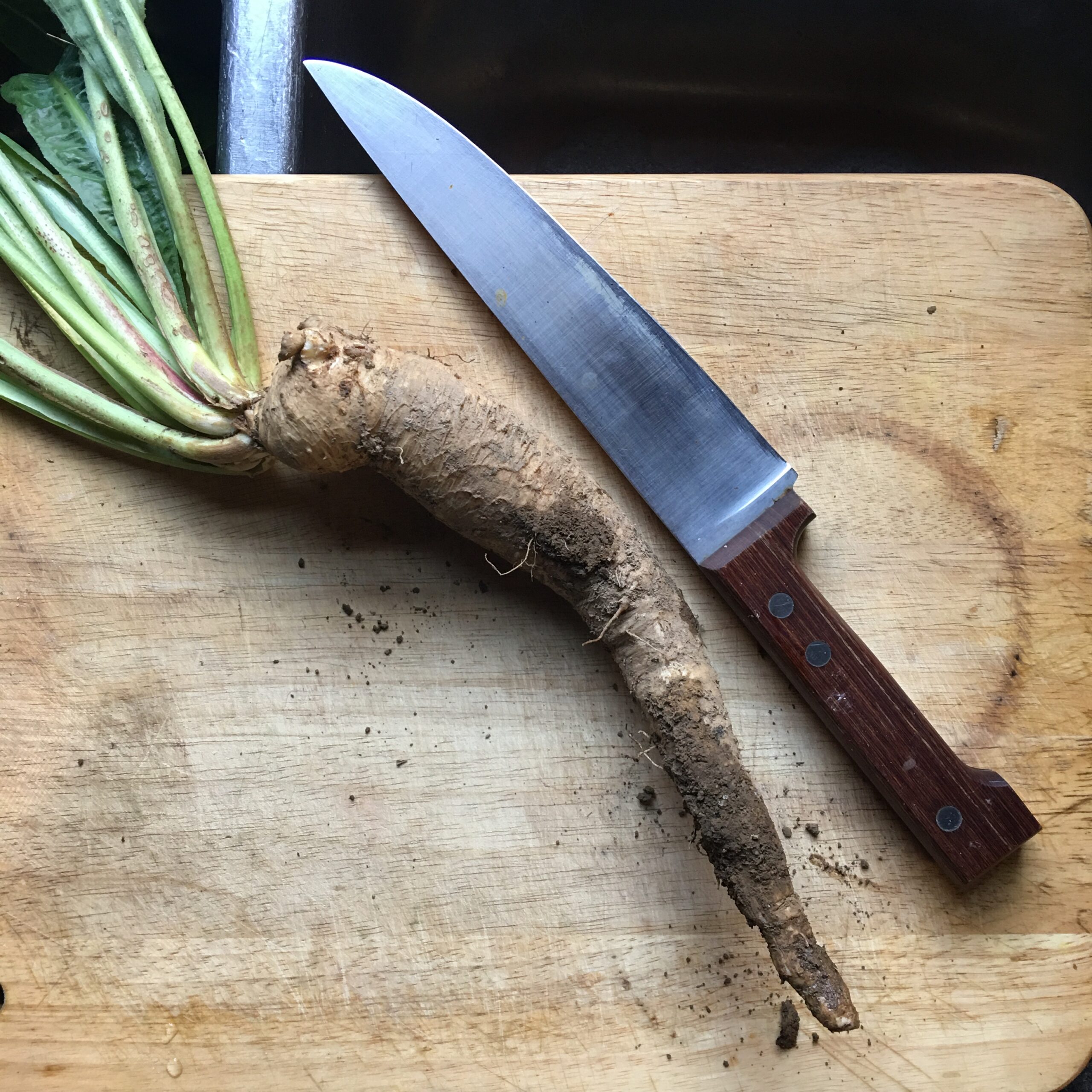
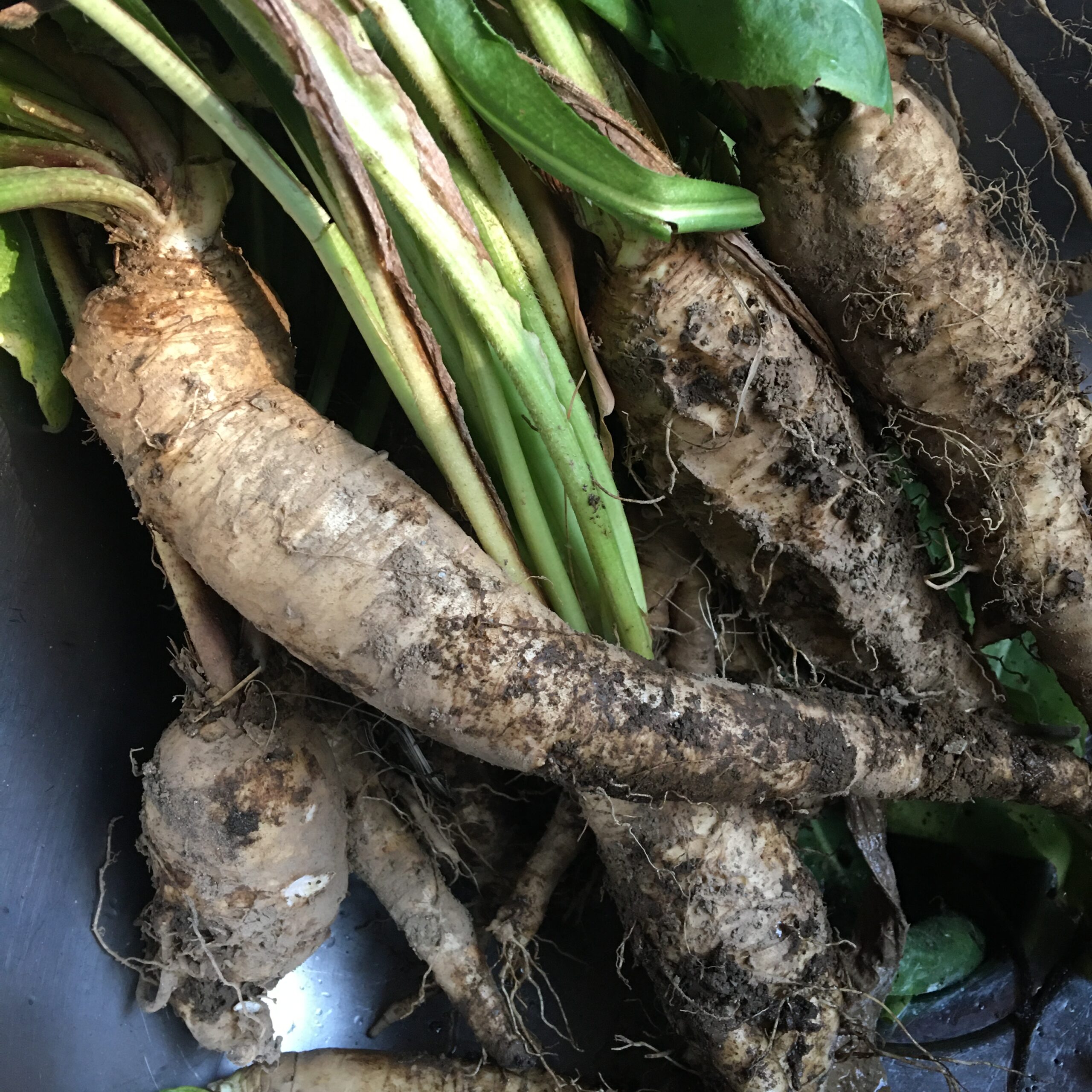
Chicory is native to Europe but has naturalized throughout the United States. It forms large, fleshy taproots that are surprisingly easy to dig up. I scattered seeds in a corner of the garden and now have a consistent supply every year and enough to keep me supplied with homemade roasted chicory root tea all winter long. Chicory can be found in waste places (wherever there is disturbed soil), fields, pastures, and along roadsides. Avoid those along the roads or anywhere chemicals are a concern.
The roots are washed, chopped and roasted similar to the way dandelion roots are roasted (see link for harvesting, roasting, and making roasted dandelion root tea: Part 1 and Part 2).
Roasted chicory root tea is an excellent beverage for its earthy and mildly bitter flavors – making it an ideal tea any time of the day. It contains no caffeine and instead offers plenty of beneficial phytonutrients (including inulin). Being mildly bitter, it is supportive of the entire digestive system so consider it as an after-dinner tea especially when blending it with warming spices such as ginger, cardamom, cinnamon, and nutmeg.
Roasting the Chicory Root
Wash the freshly dug chicory roots outdoors and cut off the tops (they make great compost!). Pay attention to soil stuck in crevices and any insect holes. Once back inside, preheat the oven to 250F. Give the roots one final wash, inspecting them and cutting out any questionable spots. With a sharp chef’s knife, cut the roots into small pieces, about the size of a pea. Try to make them relatively uniform in size so that they roast and dry at the same rate. Not feeling handy with all that chopping? Another easy method is to rough chop the roots and further work them in a food processor.
Lay the chopped roots on a baking sheet, spreading them in a thin layer. It’s faster to use two sheet pans instead of trying to pack it all onto one (trust me on this one). Roast for several hours, checking on them every so often and giving them a stir. Check more frequently as they start to dry and turn brown. The time it takes to finish depends on the size of the roots, the temperature of the oven, and the depth of the layer.
My pan often gets a little smoky towards the end of the process, so I learned to finish it off outdoors with a gas grill (with the temperature set to its lowest option). If your smoke detector also sounds like it was made for an industrial building, you might like this option, too. I like my chicory root on the darker side of roasted as it offers a more robust flavor in the final brew.
When the roots are thoroughly dried and sufficiently browned, remove from the heat and allow to cool to room temperature. The roots can be further ground using a mortar and pestle, coffee grinder, or the dry canister of a more powerful blender/mixer until they resemble the texture of ground coffee. You can do this all at once when the chicory root cools, or store them as is and grind them as needed. Store the small pieces or ground chicory in a glass jar for winter storage and place in a cool, dry location away from light. It keeps well for a year, likely longer, but I’ll never know because I tend not to have much left by the next fall regardless of how much I make each year.
Click here for Brewing Roasted Chicory Root
[ngg src=”galleries” ids=”1″ exclusions=”5,9,15″ sortorder=”4,1,3,2,6,5,7,8,9,10,12,11,13,14,15,16,17″ display=”basic_thumbnail” thumbnail_crop=”0″]Dr. Nate Petley is a naturopathic doctor and clinical herbalist. He offers a three-year herb apprenticeship in Maine and lectures throughout New England sharing his expertise in naturopathic and botanical medicine. Dr. Petley blends the art and science of herbalism in his clinic and classroom, relying on his 20 years of experience studying, wildcrafting, and making herbal medicine. Information provided is for educational purposes only. It is not intended to diagnose, treat, cure or prevent any disease, nor is it a replacement for seeking proper medical attention.To help keep this site full of information and no ads, please consider a one-time or continual donation to support this website and blog. Ads can slow down page loading, track your whereabouts, and are simply annoying to scroll over when reading an article. Click here to support.
Dr. Nate Petley, ND | www.drpetley.com | 2020. All rights reserved. All text and photos are the property of Nathaniel Petley, ND.